PieceWork, September/October 2012 Digital Edition
PieceWork, September/October 2012 Digital Edition


Couldn't load pickup availability

PieceWork, September/October 2012 Digital Edition
🔒 Order with Confidence
🔒 Order with Confidence
🔒 Order with Confidence
✅30-Day Money Back Guarantee — no risk trying it.
🚚Free shipping available. Orders processed within 24–48 hours.
🔐Secure & encrypted checkout with trusted payment providers.
What could be better than a combination of books and needlework? Welcome to PieceWork's third annual literature-inspired issue!
Did you know that there's a historical novel that uses needlework in detail to tell the story? "Love, Needlework, and History in the Bayeux Tapestry" examines The Needle in the Blood by Sarah Bower. "A Camel to Embroider in Bayeux Stitch" provides step-by-step instructions for working the famous stitch.
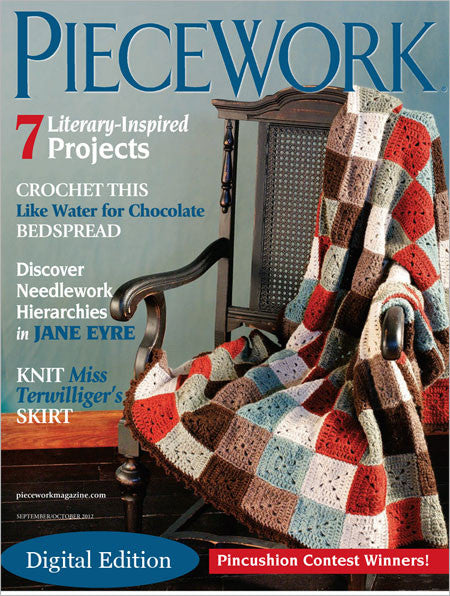
Learn about the ties that the stunning crocheted bedspread on this issue's cover has to Laura Esquivel's Like Water for Chocolate. Make your own bedspread with the instructions in "Tita's Kaleidoscope Bedspread to Crochet."
The "Mystery Yarn" chapter in Robert McCloskey's Homer Price focuses on "one of the town's best-known and best-loved citizens," yarn shop owner Miss Terwilliger. "The Great Yarn Ball Contest" offers highlights from the book that has been delighting children and adults since its publication in 1943; a pattern for knitting your own Miss Terwilliger skirt follows.
Charlotte Brontë (1816-1855) used the hierarchy of needlework to develop the characters and setting in Jane Eyre, first published in 1847. Plain sewing was at the lowest level; find out where your favorite technique placed in "Victorian Social and Needlecraft Hierarchies in Jane Eyre."
PieceWork's salute to needlework in literature is full of more literary-inspired articles and projects. Enjoy!